AfD Wins Saxony-Anhalt State Election by a Wide Margin but Falls Short of an Absolute Majority
7.9.2026
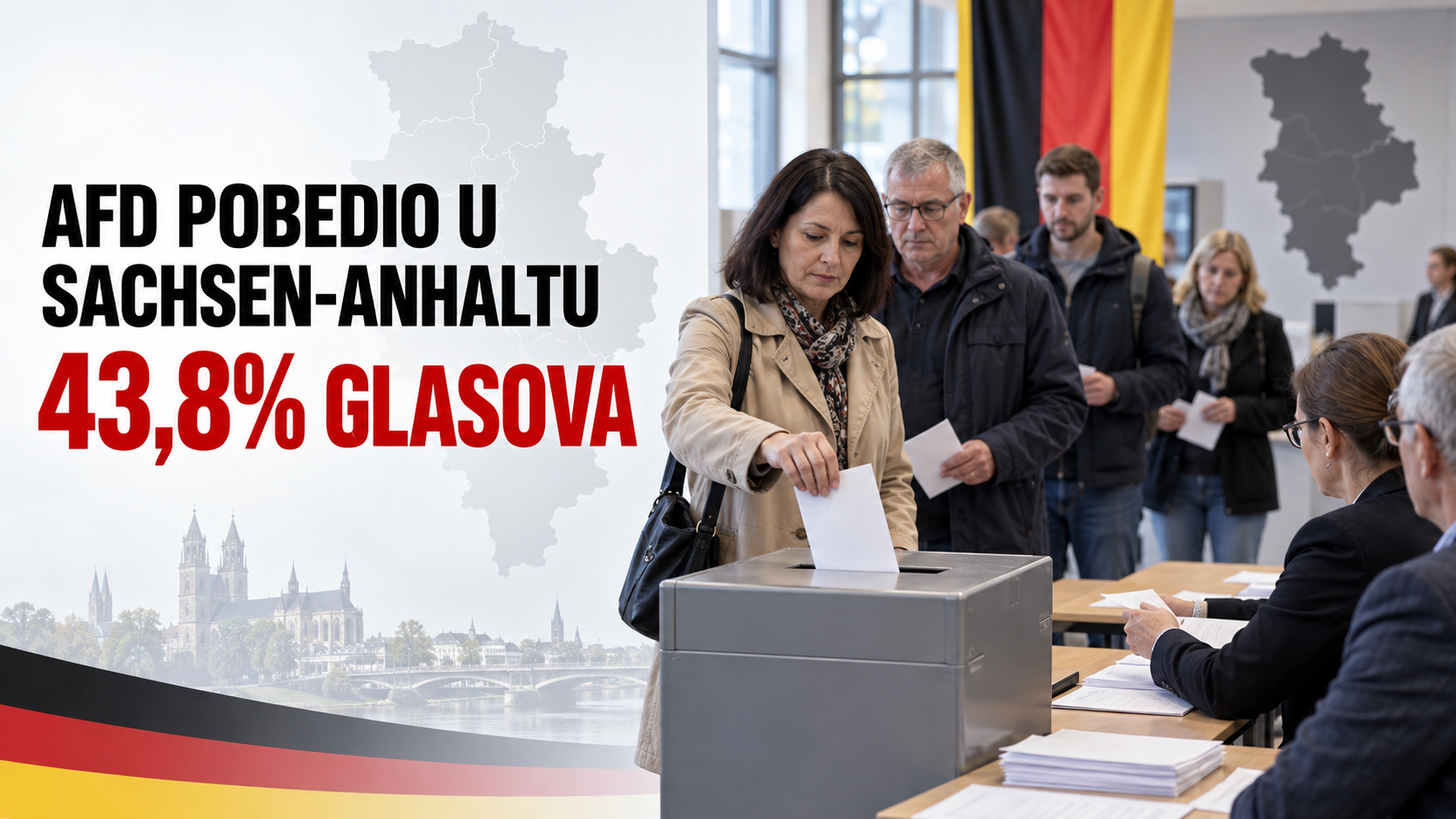
The AfD has emerged as the strongest party in Saxony-Anhalt’s state election, receiving 43.8 percent of the vote. The CDU suffered a historic defeat, while the AfD fell three seats short of the majority required to govern alone. The formation of the next state government therefore remains uncertain.
The Alternative for Germany, or AfD, has achieved a decisive victory in the state election held in Saxony-Anhalt on 6 September 2026.
According to the preliminary final result, the AfD received 43.8 percent of the vote, more than doubling its result from the 2021 election, when it won 20.8 percent.
This is the AfD’s best-ever result in an election for a German state parliament. However, it was not enough to secure an absolute majority, meaning the party cannot govern without support from other members of parliament.
Saxony-Anhalt Election Results
According to the preliminary final result, the parties received:
AfD: 43.8 percent
CDU: 17.2 percent
SPD: 9.3 percent
Alliance 90/The Greens: 8.9 percent
The Left: 8.6 percent
BSW: 5.3 percent
FDP: 2.6 percent
The FDP failed to reach the five-percent threshold and will no longer be represented in the state parliament.
The Sahra Wagenknecht Alliance, known as BSW, narrowly entered the state parliament with 5.3 percent in its first Saxony-Anhalt state election.
Voter turnout reached a record 77.8 percent. In the 2021 election, turnout was 60.3 percent.
Composition of the New State Parliament
The new Saxony-Anhalt state parliament is expected to have 83 members.
According to the preliminary result, the seats will be distributed as follows:
AfD: 39 seats
CDU: 15 seats
SPD: 8 seats
Alliance 90/The Greens: 8 seats
The Left: 8 seats
BSW: 5 seats
At least 42 votes are required for an absolute majority.
With 39 seats, the AfD does not have enough votes to elect a state premier on its own. It needs the support of at least three additional members.
Historic Defeat for the CDU
The CDU, which has governed Saxony-Anhalt since 2002, received only 17.2 percent of the vote.
This is the party’s worst-ever result in a Saxony-Anhalt state election.
In 2021, the CDU received 37.1 percent. Within five years, the party has therefore lost more than half of its previous support.
The CDU also failed to win a single direct constituency seat. According to preliminary figures, the AfD won 38 of the state’s 41 constituencies. The remaining three direct mandates went to candidates from The Left in the larger cities of Magdeburg and Halle.
The result also represents a serious political setback for Chancellor Friedrich Merz and the national CDU leadership.
Can the AfD Form a Government?
Despite its clear election victory, the AfD does not currently have a confirmed partner with which to form a state government.
The CDU, SPD, Greens and The Left had already ruled out cooperation with the AfD before the election.
BSW is the only party represented in the new parliament that has not categorically rejected talks with the AfD. BSW’s lead candidate, Thomas Schulze, stated that his party was prepared to speak with all political parties.
However, this does not necessarily mean that BSW will enter a coalition with the AfD or support the AfD candidate in the election for state premier.
Together, the AfD and BSW would have 44 seats, giving them a mathematical majority. However, the two parties disagree on several issues, including education, economic policy and the possible structure of a future government.
AfD lead candidate Ulrich Siegmund has said that he does not want to enter a coalition requiring extensive political compromises. He also raised the possibility of another election if no stable government can be formed.
Why BSW Could Play a Decisive Role
Despite holding only five seats, BSW could play a crucial role in determining the next state government.
Without BSW, neither the AfD nor the other parties have a straightforward path to a parliamentary majority.
The CDU, SPD, Greens and The Left also hold only 39 seats between them. A government excluding the AfD would therefore require additional support.
Saxony-Anhalt is consequently facing difficult and potentially lengthy negotiations over the formation of its next government.
Who Is Ulrich Siegmund?
Ulrich Siegmund was the AfD’s lead candidate in the Saxony-Anhalt election and is one of the party’s most prominent politicians in eastern Germany.
Following the announcement of the result, he said voters had made it clear that they wanted political change. The AfD considers the election result a mandate to form a government.
During the campaign, the party called for stricter migration policies, changes to the education system, stronger policing, a different energy policy and closer relations with Russia.
Since 2023, Saxony-Anhalt’s state domestic intelligence agency has classified the regional AfD organisation as a confirmed right-wing extremist entity.
The AfD rejects accusations of extremism and argues that the classification is being used to discredit the party and its voters.
What Does the Result Mean for Germany’s Federal Government?
Although this was a state election, its political significance extends beyond Saxony-Anhalt.
The result reflects considerable dissatisfaction with Germany’s federal government and the established political parties.
A survey published before the election indicated that a large majority of voters in Saxony-Anhalt were dissatisfied with the federal government’s performance.
The defeat is likely to increase pressure on Chancellor Friedrich Merz and the CDU leadership.
The AfD will probably present its victory as evidence that it is no longer merely a protest or opposition party but is capable of becoming the leading political force in individual German states.
Germany’s next federal election is scheduled for 2029. Political developments in Saxony-Anhalt will therefore be closely watched across the rest of the country.
What Does the Result Mean for Foreign Nationals and the Diaspora?
The election result does not automatically change existing residence permits, work permits, citizenship rules or the rights of foreign employees in Germany.
Saxony-Anhalt is one of Germany’s 16 federal states. A large proportion of the rules governing migration, asylum, residence and citizenship are determined at federal level or through European Union legislation.
However, state governments have important responsibilities in areas including:
education and schools
policing and internal security
state administration
integration programmes
certain areas of social policy
the implementation of some federal laws
Any specific changes will depend on which parties form the next state government and which policies are subsequently adopted.
For people from the Balkans living in other German states, the election result currently has no immediate legal consequences.
When Will the New Government Be Known?
There is no fixed deadline by which a new state premier must be elected.
In the first round of voting, a candidate requires the support of a majority of all members of the state parliament.
If the first vote fails, another round must be held within a specified period. If no state premier is elected in the second round, parliament must decide whether to end the legislative term early.
If parliament is not dissolved, a subsequent vote may be decided by a majority of the votes actually cast.
Because of the complicated distribution of seats, negotiations could last several weeks or even months.
Conclusion
The AfD has won the Saxony-Anhalt state election with 43.8 percent of the vote, achieving a historic result.
The CDU suffered its worst-ever defeat in the state, receiving only 17.2 percent. The SPD, Greens, The Left and BSW also entered the state parliament, while the FDP failed to reach the five-percent threshold.
The AfD fell three seats short of an absolute majority. Its election victory therefore does not automatically mean that the party will take control of the state government.
BSW could play a key role in the negotiations. It remains unclear whether the party will support the AfD or participate in another political arrangement.
For foreign nationals, the election result does not create any immediate changes to residence rights, work permits or citizenship rules. Concrete consequences will only become clear after a new state government is formed and begins implementing its policies.
Gastarbajter24 will continue to follow the negotiations and provide updates on important developments in Saxony-Anhalt.
Please note: This article is based on the preliminary final result published on 7 September 2026. The election result must still be formally confirmed.
Sources: Saxony-Anhalt State Returning Officer – official election information and results, Tagesschau – preliminary final result and distribution of seats, Reuters – election result and political significance