Less Waiting at the Immigration Office? Germany Is Digitalising Residence Permits – Here’s What Is Changing
28.8.2026
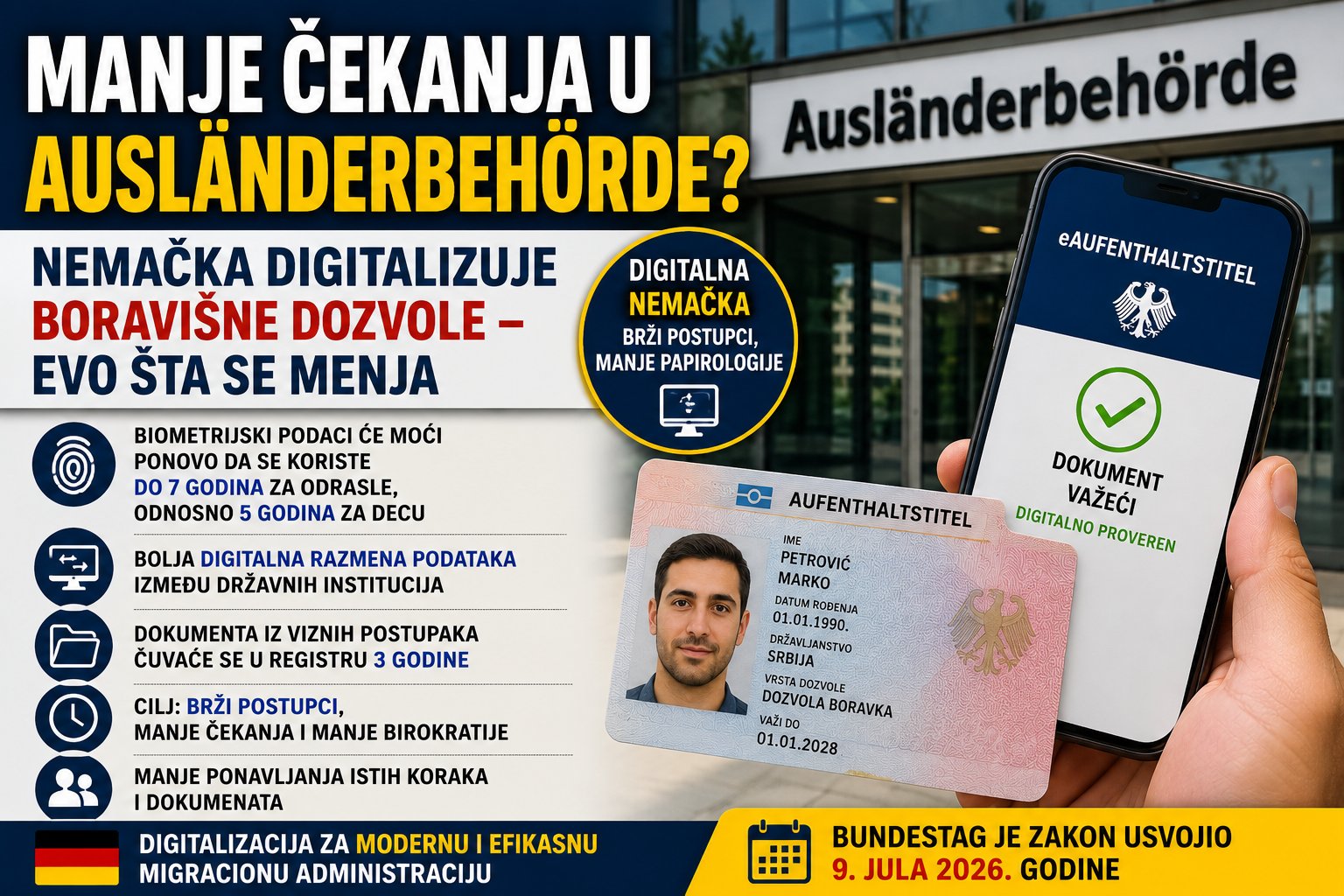
Germany is moving to further digitalise procedures at its immigration authorities (Ausländerbehörden) and reduce administrative work. The Bundestag has approved new legislation designed to improve data exchange between public authorities and speed up procedures. One of the most important changes concerns biometric data used for electronic residence permits.
Anyone who has applied for or renewed a residence permit in Germany knows the process can involve appointments, paperwork, biometric data and sometimes lengthy processing times.
Germany now wants to reduce some of that bureaucracy through further digitalisation of its migration administration.
On 9 July 2026, the German Bundestag approved legislation to further develop the digitalisation of migration administration, known in German as the Migrationsverwaltungsdigitalisierungsweiterentwicklungsgesetz (MDWG).
The goal is to reduce the workload for authorities, improve the exchange of information and make administrative procedures more efficient.
Biometric Data May Not Always Need to Be Collected Again
One of the most significant changes concerns biometric data used for electronic residence permits.
This includes information such as photographs, fingerprints and signatures.
Under the new system, biometric data that has already been provided may, under certain conditions, be reused when a person later applies for another temporary electronic residence permit.
For adults, biometric data could be reused for up to seven years.
For children, a shorter period of up to five years is planned.
In practice, this could mean that some administrative steps will no longer have to be repeated every time a new application is submitted.
What Does This Mean for Residence Permit Holders?
Consider someone who lives and works in Germany and has already provided biometric data during a previous application for an electronic residence permit.
If those details are still available in the system and the legal requirements are met, they could potentially be reused for a future application.
The aim is to save time and administrative work for both applicants and immigration authorities.
However, this does not mean that residence permits will automatically be renewed or that a new application will no longer be necessary.
Germany’s Central Register of Foreigners Will Play a Bigger Role
A key part of the reform involves Germany’s Central Register of Foreigners (Ausländerzentralregister – AZR).
Relevant information will increasingly be stored centrally and made available digitally to authorised public authorities.
The idea is straightforward: if information has already been provided to a German authority and is legally available in the system, applicants should not unnecessarily have to provide the same information again to another authority.
This should also improve communication between different government agencies.
Visa Procedures Will Also Become More Digital
The reform is not limited to residence permits.
Documents used in visa procedures will also increasingly be made available digitally.
Certain documents relevant to visa applications are expected to be stored in the appropriate section of the Central Register of Foreigners for three years.
Authorities involved in visa procedures could then access relevant information more efficiently.
The German government expects this to help speed up procedures, including those related to the immigration of skilled workers.
Less Paperwork Between Government Authorities
Another major goal of the reform is to improve digital communication between different public authorities.
Relevant information from public prosecutors and courts that needs to be available to immigration authorities should increasingly be recorded centrally through the Central Register of Foreigners.
The responsible immigration authority can then be informed that new information is available.
Instead of repeatedly sending information between different offices, existing data should be used more efficiently through digital systems.
Does This Mean Shorter Waiting Times at Immigration Offices?
Potentially in the long term – but not automatically.
The new legislation does not mean that appointments at every immigration office in Germany will suddenly become available quickly or that lengthy processing times will immediately disappear.
The situation varies significantly between German cities and districts.
Processing times continue to depend on factors including the number of applications, staffing levels at individual immigration offices and their technical infrastructure.
Digitalisation could, however, reduce repetitive administrative work.
In the long term, this could help relieve pressure on immigration authorities and allow certain procedures to be processed more efficiently.
When Will the Changes Take Effect?
There is an important distinction to make.
Although the Bundestag approved the legislation on 9 July 2026, this does not mean that all of the new digital functions are immediately available at every immigration office.
The necessary technical infrastructure first needs to be established, particularly for the storage and reuse of biometric data.
Germany’s Federal Office of Administration must provide the relevant technical capabilities within the Central Register of Foreigners, while immigration authorities also need systems capable of transmitting and accessing the data.
Applicants should therefore not assume that previously submitted biometric data can already be reused for every new residence permit application.
What Could This Mean for People from the Western Balkans?
The reform could be particularly relevant in the long term for people from Serbia, Bosnia and Herzegovina, Montenegro, North Macedonia, Kosovo and other countries who live in Germany.
Many foreign nationals regularly need to deal with immigration authorities, for example when applying for or renewing a temporary residence permit.
If existing information can be reused and data exchanged more efficiently between government authorities, some repetitive administrative steps could eventually be reduced.
However, the reform does not remove the legal requirements for obtaining or renewing a residence permit.
Applicants will still have to submit applications and provide any documents or evidence required by law.
The main change concerns how German authorities store, exchange and reuse information that has already been collected.
The Goal: Faster Procedures and Less Bureaucracy
Germany is continuing the digitalisation of its migration administration with the aim of making procedures more efficient.
Better digital data exchange could reduce unnecessary paperwork and duplicated administrative work for both applicants and government employees.
For people dealing regularly with immigration authorities, this could eventually mean simpler procedures and potentially faster processing.
How much applicants actually notice the improvements at their local immigration office will depend largely on how quickly the required technical systems are implemented and how individual authorities use the new possibilities in practice.
Important: The reform does not mean that residence permits will be automatically renewed or that appointments with immigration authorities will no longer be necessary. Applicants should continue to follow the requirements of their local immigration office.
Sources: German Federal Government / German Bundestag
Information current as of 28 August 2026