Change of Government in Serbia: Will Our People Now Return from Germany ?
28.10.2026
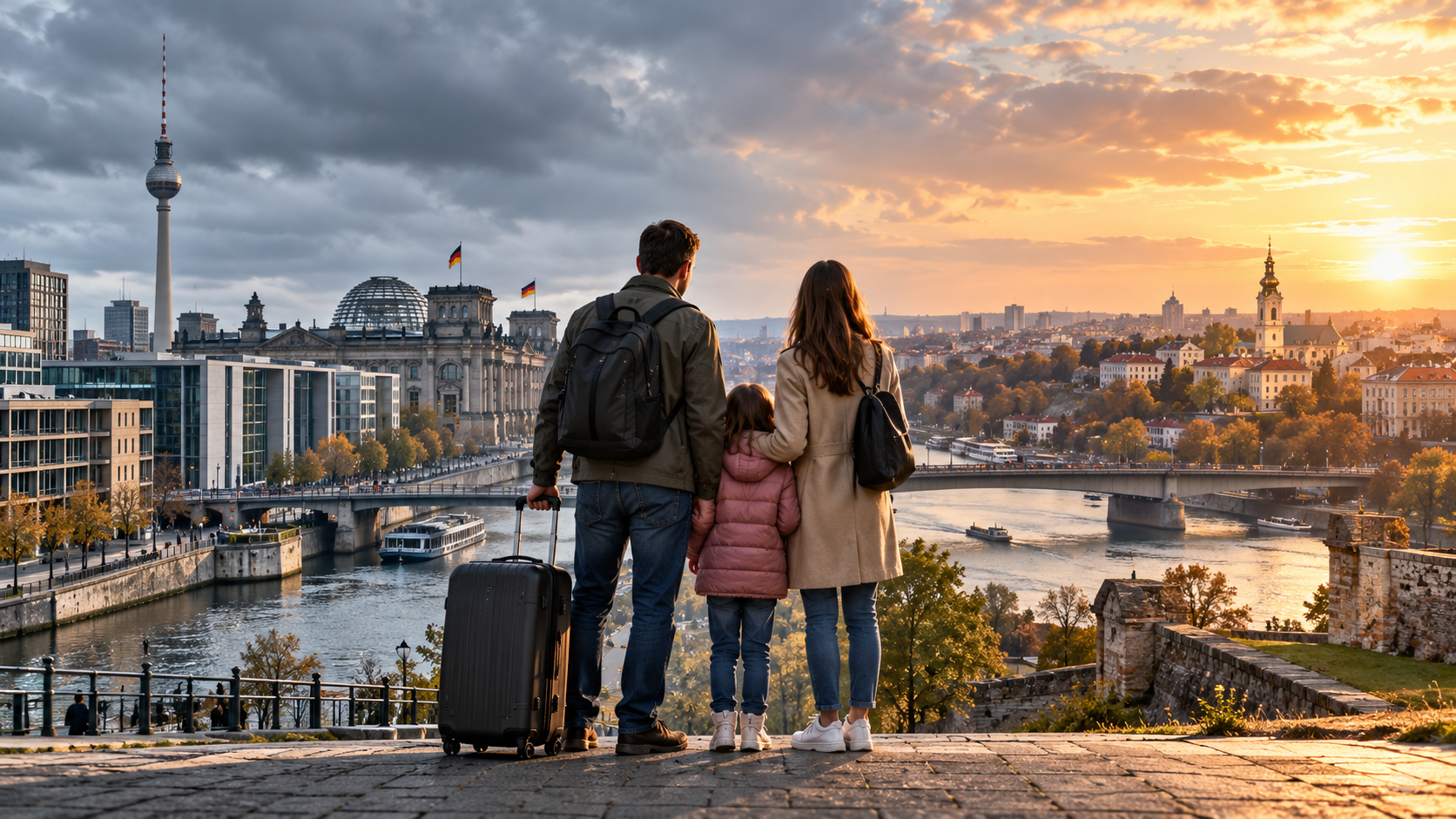
The results of Serbia’s snap parliamentary election have brought a major political shift. The student-backed list won more than half of the vote and, according to the preliminary results, secured enough seats to form a new government.
Although the formal process has not yet been completed and the current government will remain in a caretaker capacity until a new one is elected, Serbia appears to be facing its most significant change of government in 14 years.
At the same time, Germany is going through a period of economic uncertainty, a weaker labour market and persistently high living costs. This has prompted an increasingly common question among members of our community:
Could political change in Serbia encourage part of the diaspora to return home?
Political change brings new hope
According to the preliminary results, the student-backed list received approximately 52.7% of the vote, while the coalition surrounding the outgoing government won around 39.2%.
This result could give the student-backed movement approximately 140 of the 250 seats in parliament, potentially allowing it to form a government without a coalition partner.
However, the transfer of power has not yet been formally completed. The final election results must first be confirmed, the new National Assembly must be constituted and a new government must then be elected.
Until that happens, the existing government will continue to serve in a caretaker capacity.
For many citizens—particularly young and highly educated people who have left Serbia in recent years—the election result represents a new source of hope. Expectations include stronger institutions, a more effective fight against corruption, greater legal certainty, freer media and better conditions for living and doing business.
However, political change alone will not automatically lead to the return of the diaspora.
Germany’s economy is growing, but the labour market remains weak
Germany’s economic situation is not straightforward. According to the German government’s autumn forecast, the country’s economy is expected to grow by approximately 1.3% in 2026.
This means that Germany is not experiencing a conventional recession, and a gradual recovery is expected. However, not everyone is feeling the benefits of that recovery.
In September 2026, approximately 2.99 million people were registered as unemployed in Germany, while the unemployment rate stood at 6.4%. The number of people in employment was lower than a year earlier, and fewer job vacancies were registered.
Companies continue to face high energy prices, weak consumer demand, limited investment and a rising number of insolvencies. Inflation, high housing costs and everyday expenses are placing additional pressure on household budgets.
As a result, many people from the Balkans are beginning to ask whether living in Germany is still as financially worthwhile as it was several years ago.
Will there be a mass return?
There are currently no indications that Germany will immediately experience a large wave of people returning to Serbia.
Most of our people in Germany will not make such a decision based solely on the result of one election. Many have stable jobs, children attending German schools, mortgages, property and family obligations.
For them, returning is not simply an emotional or political question. It affects employment, income, health insurance, their children’s education, pension rights and the future of the entire family.
Even those who welcome the political change are likely to wait for concrete results.
The new government will have to demonstrate that it can create more stable institutions, greater legal certainty, better healthcare and education, improved conditions for private companies and more adequately paid jobs.
Who might return first?
If the announced reforms prove successful, returning could first become attractive to those who left Serbia relatively recently and still have strong family or business connections to the country.
Potential returnees could include:
people who can work remotely for German or international companies;
skilled workers and tradespeople who could start their own businesses in Serbia;
entrepreneurs willing to invest the capital and experience they gained in Germany;
families who already own a house or apartment in Serbia;
people approaching retirement who want to live closer to their relatives;
individuals facing unemployment or high housing costs in Germany.
Not everyone will necessarily choose a traditional permanent return. Some may live between the two countries, work for a German company from Serbia or establish a business connecting the German and Serbian markets.
The first consequence of political change could therefore be greater interest among the diaspora in investing and doing business in Serbia. A noticeable increase in permanent returns may follow only later.
Income and living standards remain decisive
The greatest obstacle to returning is still the significant difference in earnings between Germany and Serbia.
Although the cost of living in Germany has increased, wages remain considerably higher and the social security system is more developed. Unemployed people, families with children, those who are ill and pensioners generally benefit from broader institutional support than in Serbia.
On the other hand, life in Serbia may be more affordable for people who already own a home there and continue to receive income from abroad.
Someone who can work remotely while earning a German salary is in a completely different position from a person who would need to find employment with a Serbian company after returning.
Political change may therefore provide an important incentive, but it will not be enough without measurable economic progress.
The diaspora will judge the new government by its results
People living abroad often follow developments in Serbia very closely. Many would like to return one day, but they do not want to risk the security they have spent years building in Germany.
The new government will therefore have to earn the diaspora’s trust through concrete measures.
These should include predictable laws, more efficient courts, simpler procedures for starting a business, less bureaucracy, transparent institutions and a credible fight against corruption.
Serbia will also need a serious programme for returnees—covering everything from the recognition of foreign qualifications and professional experience to tax incentives, support for starting a business and easier integration of children into the Serbian education system.
Without such measures, calls for the diaspora to return will remain little more than political messages.
Germany has not lost its appeal
Despite its current economic challenges, Germany remains one of Europe’s largest and most developed economies.
Workers are still needed in healthcare, skilled trades, construction, transport, education and numerous technical professions. For many people from the Balkans, Germany will therefore continue to offer higher incomes, a more reliable system and greater professional opportunities.
It is consequently unlikely that political change in Serbia will trigger a sudden wave of departures from Germany.
A more realistic scenario is that part of the diaspora will begin to consider returning more seriously, observe the new government’s first results and reassess their long-term plans.
Conclusion
The change of government could mark the beginning of a new chapter for Serbia. However, it remains to be seen whether political promises will be transformed into genuine reforms.
At the same time, Germany’s weaker labour market and high living costs could encourage some of our people to consider alternatives.
Nevertheless, the decision to return will not be made overnight.
If Serbia becomes a country with more reliable institutions, a better business environment and a decent standard of living over the coming years, the number of people returning could gradually increase.
If the changes amount to little more than new names in government institutions, most members of the diaspora will probably continue building their lives in Germany.
Political change can awaken the desire to return. But only concrete results can truly bring people back.
Sources
Government of Serbia – Peaceful transfer of power and caretaker government
Reuters – Election results and the formation of a new government
European Commission – Statement on Serbia’s parliamentary election
German Federal Ministry for Economic Affairs – Autumn economic forecast
German Federal Employment Agency – The labour market in September 2026